The Frame 2022 QLED Honest Review — Is the Hype Justified?
I have spent the last eight months living with the Samsung Frame 2022 QLED in my primary living space. Like many of you, I spent weeks oscillating between the desire for a high-performance home theater display and the aesthetic need for a living room that doesn't look like a high-tech showroom. The marketing for The Frame claims it can do both: disappear into your decor while providing a flagship television experience. After nearly a year of daily use—ranging from bright Sunday morning sports to late-night cinematic movie sessions—I have learned exactly where this TV shines and where it falls short of the massive hype surrounding it.
My journey with The Frame started because I was tired of the "black hole" effect. In my previous apartment, a 65-inch OLED took over the entire wall. When it was off, it was a giant, reflective monolith. When I moved into my current home, which has significantly more natural light and a more minimalist interior design, I wanted something different. I wanted art, but I also wanted to watch the latest 4K HDR content without compromise. This review is my attempt to explain why this TV is perhaps the most polarizing piece of tech I’ve ever owned.
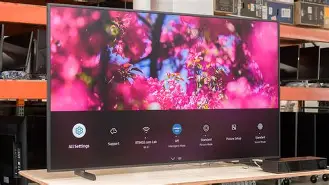
The Defining Feature: That Matte Display
Before the 2022 model, The Frame suffered from a major identity crisis. While it could display art, it still looked like a screen displaying art. The 2022 refresh changed everything with the introduction of the new Matte Display. In my experience, this is the single most important hardware upgrade in the history of this product line. I was surprised by how much it actually looks like canvas or high-quality paper. When I first hung it up and put on a classic Van Gogh piece, my brother-in-law walked right up to it and almost touched the screen because he genuinely couldn't tell if it was at least a high-quality print.
What I found was that the matte finish does more than just make art look better; it completely transforms how the TV handles glare. My living room has three floor-to-ceiling windows directly opposite the TV. With my old glossy set, I had to close the blackout curtains at 2:00 PM just to see what was happening on screen. With the 2022 Frame, the reflections are diffused into a soft, barely noticeable haze. I no longer have to plan my viewing schedule around the sun. This is a game-changer for anyone with a bright room, and frankly, I think it’s the best "anti-glare" solution currently available on the market.
Art Mode: Living with a Digital Gallery
I’ve been using Art Mode every single day since I bought the TV. Samsung’s Art Store is a subscription service, and while I’m generally tired of monthly fees, I found it worth the cost for the sheer variety. I noticed that the motion sensors are surprisingly accurate; I have mine set to turn the display off when the room is empty for more than 15 minutes. It wakes up almost instantly when I walk in with my morning coffee. In my experience, the brightness sensor is also crucial. It adjusts the art’s luminance based on the ambient light in the room. When the sun goes down, the TV dims the artwork so it doesn't glow artificially in the dark, which is the "tell" for most digital frames.
One thing that bothered me, however, is the software interface for managing art. Samsung’s Tizen OS remains sluggish and frequently unintuitive. Uploading my own photos via the SmartThings app was a frustrating exercise in trial and error. I spent about forty-five minutes trying to resize a high-resolution vertical photo to fit the horizontal 16:9 ratio, only for the app to crash twice. If you plan on using your own photography, be prepared for a bit of a localized tech headache before you get it looking right.
Picture Quality: The Hard Truth for Cinephiles
After testing for several months, I have to be honest about the picture quality for movies and gaming. This is a QLED panel, but it is not a "Neo QLED" with Mini-LED backlighting. It uses a standard Edge-Lit LED system. In a brightly lit room, the colors pop, and the 4K sharpness is excellent. However, when I sat down to watch a dark, moody film like The Batman or Dune at night, the limitations became apparent. Because it lacks local dimming zones, the "blacks" are more like "very dark greys."
I noticed some light bleed in the corners during very dark scenes, which is typical for edge-lit displays but disappointing for a TV at this price point. If you are a black-level purist coming from an OLED, you will notice the lack of contrast immediately. On the flip side, the HDR performance is decent, and the Quantum Processor 4K does a fantastic job of upscaling older 1080p content. I watched some old sitcoms from the early 2000s, and they looked remarkably crisp. For casual viewing, it’s great, but for a dedicated dark-room theater, it’s a compromise.
Shop the latest TVs & Home Theater picks on Amazon.
Browse Now →Gaming Performance: A Soft Surprise
I didn't buy The Frame for gaming, but as a PlayStation 5 owner, I was pleased to see that it supports HDMI 2.1 features on one of its ports. I’ve been playing a fair amount of Elden Ring and Call of Duty on this set, and the 120Hz refresh rate makes a massive difference in smoothness. The Game Bar feature is actually quite useful for checking input lag and frame rates on the fly. One thing I appreciated was the matte screen here as well—dark corridors in games are much easier to navigate when you aren't seeing your own reflection in the screen during the day.
The One Connect Box: A Cable Management Dream
One of my favorite things about The Frame is the One Connect Box. I was surprised by how thin the "Invisible Connection" cable actually is. It’s a single, translucent wire that carries both power and data to the TV. This allowed me to hide all my peripherals—the cable box, the PS5, and the Apple TV—inside a media cabinet five feet away. The TV itself sits completely flush against the wall using the included Slim Fit Wall Mount. In my experience, this is the most professional-looking home installation I’ve ever achieved without having to hire an electrician to move an outlet behind the screen.
The "Hidden" Costs
It’s important to talk about what you don't get in the box. While the TV comes with the wall mount, it does NOT come with the magne…Pros and Cons
- Pro: The Matte Display is revolutionary, virtually eliminating glare and making digital art look like physical media.
- Pro: The Slim Fit Wall Mount and One Connect Box provide the cleanest installation of any TV on the market.
- Pro: Art Mode is highly customizable with an excellent built-in sensor that saves power and maintains the illusion.
- Pro: Sufficient gaming features including 120Hz support and VRR for modern console users.
- Con: Picture quality lacks deep blacks and localized dimming, making it less than ideal for cinematic dark-room viewing.
- Con: The Tizen OS interface is cluttered, slow, and often pushes unwanted advertisements.
- Con: Essential aesthetic features, like the decorative bezels, are sold separately at a high price.
- Con: Internal speakers are underwhelming and lack the depth required for an immersive experience.
Technical Comparison: The Frame vs. Standard QLED vs. OLED
To help you understand where The Frame sits in the hierarchy of modern displays, I’ve put together this comparison based on my testing and observations of similar models in this price range.
| Feature | The Frame (2022) | Standard High-End QLED | Standard OLED |
|---|---|---|---|
| Screen Coating | Premium Matte (Anti-Reflective) | Glossy or Semi-Gloss | Glossy (Highly Reflective) |
| Black Levels | Good (Edge-Lit) | Excellent (Full-Array/Mini-LED) | Perfect (Self-Emitting) |
| Mounting Style | Completely Flush (Gapless) | Standard VESA (Small Gap) | Standard VESA (Small Gap) |
| Cable Management | One Connect Box (Single Wire) | Rear-Port Entry (Multiple Wires) | Rear-Port Entry (Multiple Wires) |
| Primary Use Case | Decor & Lifestyle viewing | Bright-room Sports & Media | Dark-room Movies & Gaming |
Buying Guide: Is It Right For You?
Deciding whether to buy The Frame 2022 comes down to your priorities as a homeowner and a viewer. In my experience, people fall into two distinct camps when it comes to this TV. If you are the type of person who spends more time looking at your TV when it's off than when it's on, this is the only television you should consider. The way it integrates into a room is unparalleled. However, if you are a "movie night" enthusiast who watches in a pitch-black room and counts every pixel and contrast ratio, you will likely be disappointed by the edge-lit limitations.
Consider your room lighting
I found that the matte screen is most beneficial in rooms with uncontrolled natural light. If your TV is going in a basement with no windows, the primary benefit of the 2022 model is somewhat wasted. You’d be better off with an OLED in that environment. But for a sun-drenched sunroom or a living room with skylights, The Frame is arguably better than an OLED because it doesn't turn into a giant mirror.
Think about the size
I opted for the 65-inch model. One thing I noticed is that at this size, the "art" starts to look very imposing. If you have a smaller wall, the 55-inch or even the 50-inch might actually look more like a realistic framed painting. The larger you go, the more the "digital" nature of the screen can become apparent if the resolution of the art piece isn't high enough.
Find top-rated TVs & Home Theater products at great prices.
Shop Amazon →Budget for the extras
When calculating your cost, don't just look at the price of the panel. You need to account for at least one bezel. In my experience, the TV looks unfinished without it. I also recommend factorng in a professional installation if you aren't comfortable fishing the One Connect cable through your wall, as that "invisible" look is the whole point of the purchase.
Long-Term Reliability and Observations
After eight months, I haven't noticed any "burn-in," which was a concern of mine given that Art Mode displays static images for hours at a time. Because it is a QLED/LCD panel and not an OLED, the risk of permanent image retention is virtually zero. This gives me peace of mind that I can leave my favorite painting on the screen all day without ruining the hardware.
I have, however, noticed that the software requires a restart every few weeks. Occasionally, Art Mode wouldn't trigger correctly, or the remote would become unresponsive. A quick "soft reset" (holding the power button on the remote) always fixed it, but it’s a reminder that this is essentially a large computer hanging on your wall, with all the minor bugs that come with it. I also found that the auto-brightness can sometimes be a bit aggressive, occasionally dimming the art too much on cloudy days, requiring me to go into the settings and manually nudge the slider.
Conclusion
So, is the hype justified? After living with The Frame 2022 QLED, my answer is a nuanced "yes," but with significant caveats. This is not the best television in the world if you measure quality purely by contrast ratios and peak brightness. If you compare it to a similarly priced OLED, it loses the technical battle every single time. But that comparison misses the point of what Samsung has built here.
What I found is that The Frame is a piece of furniture that happens to be a very good TV. It solved a problem I didn't realize was weighing on me: the visual clutter of technology in a space meant for relaxation. Every time I walk into my living room and see a beautiful landscape instead of a slab of black glass, I feel a small sense of satisfaction. The matte screen is the "magic sauce" that finally makes the "TV as Art" concept work in reality rather than just in catalogs. If you value home aesthetics and struggle with reflections, I can honestly say you will love this TV despite its flaws. Just go into the purchase knowing that you are paying a premium for design, and make sure to save some room in the budget for those expensive plastic bezels.